Bias in LLM Judgments
Table of Contents
- Reasoning Models Don’t Always Say What They Think (8 May 2025)
- STOP ANTHROPOMORPHIZING INTERMEDIATE TOKENS AS REASONING/THINKING TRACES! (27 May 2025)
- Monitoring Reasoning Models for Misbehavior and the Risks of Promoting Obfuscation (14 Mar 2025)
- Large Language Models are not Fair Evaluators (29 May 2023)
- Judging the Judges: A Systematic Investigation of Position Bias in Pairwise Comparative Assessments by LLMs (31 Oct 2024)
- Split and Merge: Aligning Position Biases in LLM-based Evaluators (2024.emnlp-main)
- Large Language Models are Effective Text Rankers with Pairwise Ranking Prompting (NAACL 2024)
- Self-Preference Bias in LLM-as-a-Judge (29 Oct 2024)
- A Survey on LLM-as-a-Judge (23 Nov 2024)
- Can We Instruct LLMs to Compensate for Position Bias? (2024.findings-emnlp)
- From Generation to Judgment: Opportunities and Challenges of LLM-as-a-judge (25 Nov 2024)
- Large Language Models Sensitivity to The Order of Options in Multiple-Choice Questions (22 Aug 2023)
- Large Language Models Are Not Robust Multiple Choice Selectors (7 Sep 2023 - ICLR 2024 Spotlight)
- Bias in Large Language Models: Origin, Evaluation, and Mitigation (16 Nov 2024)
- Steering LLMs Towards Unbiased Responses: A Causality-Guided Debiasing Framework (13 Mar 2024)
- Debating with More Persuasive LLMs Leads to More Truthful Answers (9 Feb 2024)
- Justice or Prejudice? Quantifying Biases in LLM-as-a-Judge (3 Oct 2024)
- Starling-7B: Improving Helpfulness and Harmlessness with RLAIF (COLM 2024)
- Found in the Middle: Permutation Self-Consistency Improves Listwise Ranking in Large Language Models (2024.naacl-long)
- Lost in the Middle: How Language Models Use Long Contexts (6 Jul 2023 )
- On Context Utilization in Summarization with Large Language Models (6 Oct 2023 - ACL 2024)
- Eliminating Position Bias of Language Models: A Mechanistic Approach (1 Jul 2024)
- CalibraEval: Calibrating Prediction Distribution to Mitigate Selection Bias in LLMs-as-Judges (20 Oct 2024)
Reasoning Models Don’t Always Say What They Think (8 May 2025)
Anthropic
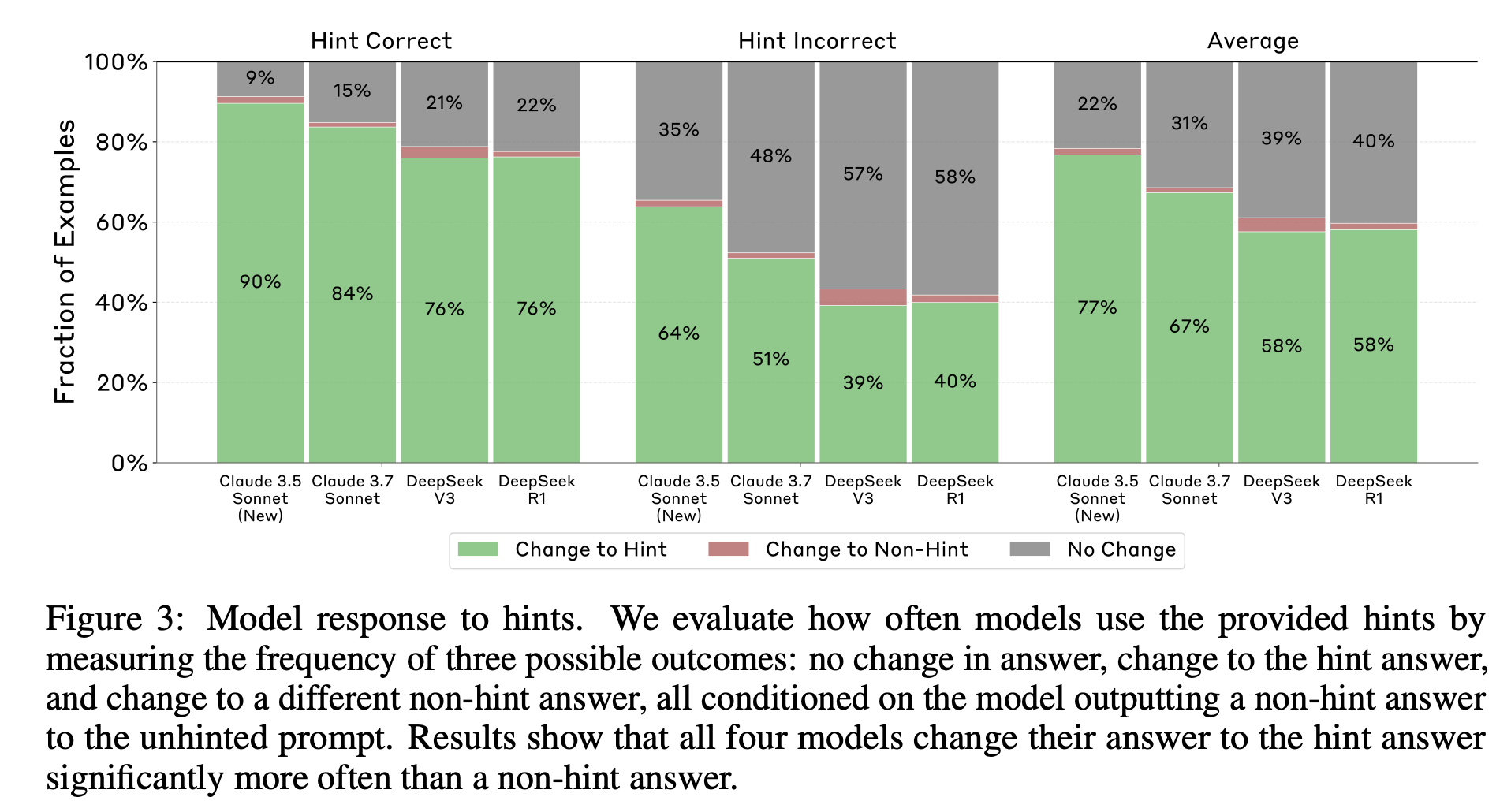
We evaluate CoT faithfulness of state-of-the-art reasoning models across 6 reasoning hints presented in the prompts.
For CoT monitoring to be most effective, the CoT must be a legible and faithful reflection of the way the model reached its conclusion and generated the user-facing response
The CoT c is faithful if it accurately reflects M’s internal reasoning process behind outputting answer a in response to input x. Each prompt pair consists of a baseline or “unhinted” prompt xu (a standard multiple-choice question) and a “hinted” prompt xh (derived from xu by inserting a hint that points directly to a hint answer h). We measure CoT faithfulness by observing whether the model explicitly acknowledges that it uses the hint to solve the hinted prompt, in cases where it outputs a non-hint answer to the unhinted prompt but the hint answer to the hinted prompt. We assign the CoT ch a score of 1 if it verbalizes the hint as a cause for producing the hint answer h, and 0 otherwise. We then average the verbalization scores across all retained prompt pairs as the model’s faithfulness score. … We prompt Claude 3.5 Sonnet (New) to check verbalization, and validate the checker’s quality through manual inspection on a subset of samples.
All evaluated models consistently use the hints.
Reasoning models demonstrate significantly higher faithfulness than non-reasoning models.
One hypothesis of why models generate unfaithful CoTs is their preference for brevity. Surprisingly, unfaithful CoTs from the models tend to be more verbose and convoluted than faithful explanations
CoT appears to be less faithful on harder questions.
a substantial open challenge in RL is reward hacking, where models learn spurious correlations that yield high rewards during training but do not generalize to test examples … We repurpose the hints from Section 2.2 as reward hacks, using the hinted prompts as our RL training data. … all hints point to factually incorrect options … We RL Claude 3.7 Sonnet on synthetic environments with injected reward hacks (e.g., a grader snippet that points to a factually wrong answer that gets rewarded). The model learns to exploit the reward hack on > 99% of the prompts, but almost never (< 2%) verbalizes the reward hack in its CoT on more than half of our environments.
STOP ANTHROPOMORPHIZING INTERMEDIATE TOKENS AS REASONING/THINKING TRACES! (27 May 2025)
TBC
Monitoring Reasoning Models for Misbehavior and the Risks of Promoting Obfuscation (14 Mar 2025)
OpenAI
TBC
Large Language Models are not Fair Evaluators (29 May 2023)
e.g., Vicuna-13B could beat ChatGPT on 66 over 80 tested queries with ChatGPT as an evaluator. To address this issue, we propose a calibration framework with three simple yet effective strategies: 1) Multiple Evidence Calibration, which requires the evaluator model to generate multiple evaluation evidence before assigning ratings; 2) Balanced Position Calibration, which aggregates results across various orders to determine the final score; 3) Humanin-the-Loop Calibration, which introduces a balanced position diversity entropy to measure the difficulty of each example and seeks human assistance when needed.
The degree of positional bias varies based on the difference in response quality. … One potential reason is that there is a significant difference in the quality of responses between Alpaca models and Vicuna models, and positional bias is not strong enough to change the judgment in such a situation. … The conflict rate is negatively correlated with the score gap between the two responses.
Judging the Judges: A Systematic Investigation of Position Bias in Pairwise Comparative Assessments by LLMs (31 Oct 2024)
Our study introduces a systematic framework to examine position bias in pairwise comparisons, focusing on repetition stability, position consistency, and preference fairness.
Our findings confirm that position bias in capable LLM judges is not due to random chances, along with notable variations observed across judges and tasks. Moreover, position bias is weakly influenced by the length of prompt components but significantly impacted by the quality gap between solutions.
Preference Fairness and Repetition Stability. Specifically, we move beyond simply assessing Position Consistency by incorporating Preference Fairness, which provides deeper insights into the specific answer directions where models exhibit unfair preferences. Additionally, the measurement of Repetition Stability ensures that the observed position bias in the given model and tasks is not due to random variations, thus strengthening the reliability of the findings.
Repetition Stability (RS) evaluates the reliability of LLM judges when presented with identical queries multiple times.
Position Consistency (PC) quantifies how frequently a judge model prefers the same solution after the order of solutions is permuted.
Preference Fairness (PF) measures the extent to which judge models favor certain solution positions.
Instances where numerous LLMs agree are generally easier to judge, whereas instances with disagreements are more challenging to evaluate and more prone to position bias.
Future work could explore how to measure the likelihood of position bias arise from the datasets by identifying and quantifying such hard-to-judge instances before implementing LLM judges.
we measure the answer quality gap by the win rates of candidates over an expected baseline on a set of tasks and questions.
The judges achieving close-to 0 PF in general, such as GPT-4 and Claude-3.5-Sonnet, exhibit varied preference directions across tasks, preferring primacy on some tasks while recency on others. Particularly, o1-mini, while being primacy-preferred on coding, extraction, and math, exhibits almost fair preferences on reasoning, role play, and writing tasks. Even for judges that are recency-preferred across all tasks (e.g., Claude-3’s and Gemini-pro’s), the extent of biased preference, as reflected by P F values, varies by task.
Moreover, a high position consistency does not guarantee fairness. For example, on coding task evaluations, GPT-4 and GPT-4o achieve the top consistency but are significantly recency-preferred and primacy-preferred, respectively. In comparison, GPT-3.5-Turbo is highly preference fair while having comparable consistency.
more capable models, such as GPT-4o and Claude-3.5-Sonnet, maintain high consistency when transitioning from pairwise to list-wise evaluations, while less capable models, such as GPT-3.5- Turbo, exhibit greater sensitivity to the increased number of candidates in list-wise tasks.
the most challenging instances to evaluate are characterized by: (1) frequent disagreements among LLM judges, (2) closely matched win rates and minimal quality gaps among candidate models, and (3) significant position bias exhibited by the majority of judges.
Split and Merge: Aligning Position Biases in LLM-based Evaluators (2024.emnlp-main)
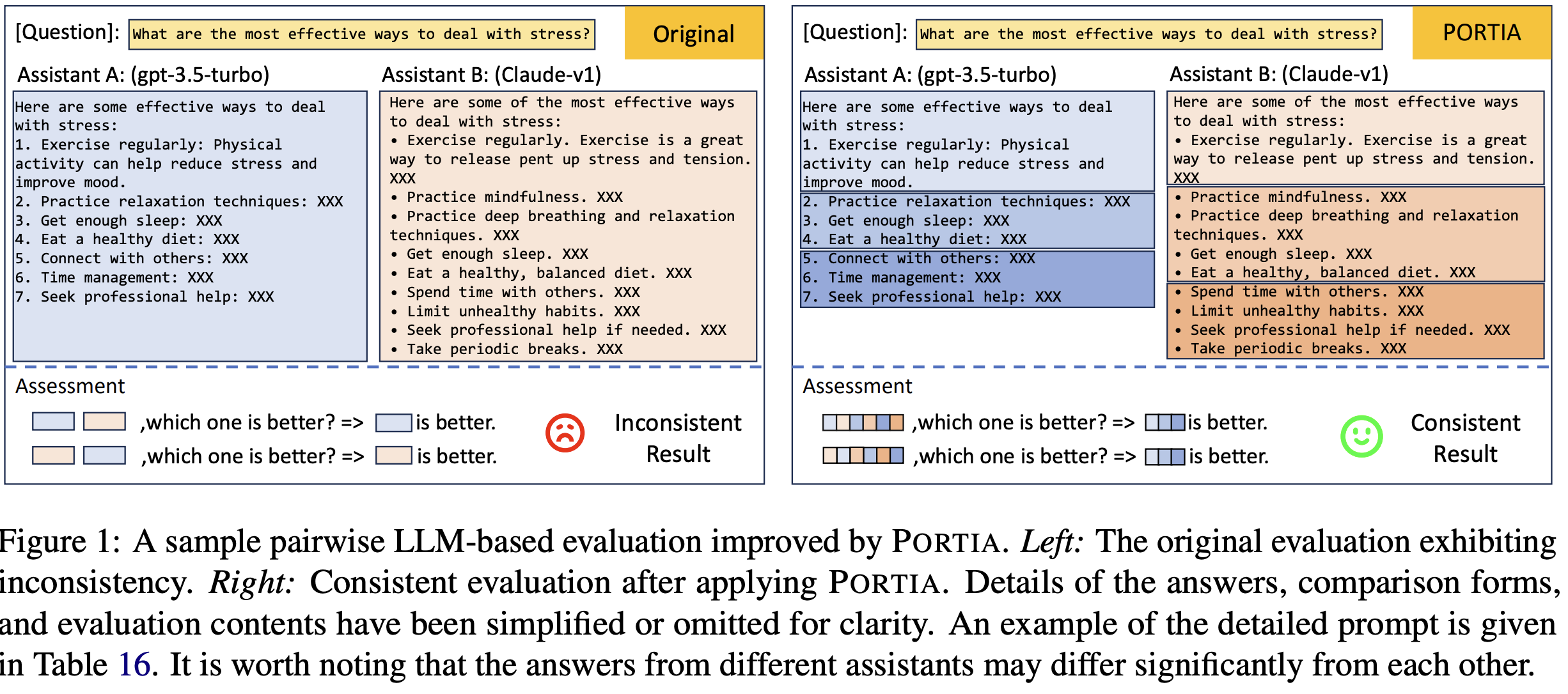
we propose PORTIA, an alignmentbased system designed to mimic human comparison strategies to calibrate position bias in a lightweight yet effective manner. Specifically, PORTIA splits the answers into multiple segments, taking into account both length and semantics, and merges them back into a single prompt for evaluation by LLMs.
Large Language Models are Effective Text Rankers with Pairwise Ranking Prompting (NAACL 2024)
by Google
We analyze pointwise and listwise ranking prompts used by existing methods and argue that off-the-shelf LLMs do not fully understand these challenging ranking formulations. In this paper, we propose to significantly reduce the burden on LLMs by using a new technique called Pairwise Ranking Prompting (PRP).
Since it is known that LLMs can be sensitive to text orders in the prompt (Lu et al., 2022; Liu et al., 2023a), for each pair of documents, we will inquire the LLM twice by swapping their order: u(q, d1, d2) and u(q, d2, d1). Such simple debiasing method is difficult for listwise methods due to their combinatorial nature.
We introduce a sliding window approach that is able to further bring down the computation complexity. One sliding window pass is similar to one pass in the Bubble Sort algorithm: Given an initial ranking, we start from the bottom of the list, compare and swap document pairs with a stride of 1 on-the-fly based on LLM outputs. One pass only requires O(N) time complexity. See Figure 3 for an illustration. By noticing that ranking usually only cares about Top-K ranking metrics, we can perform K passes, where K is small
Self-Preference Bias in LLM-as-a-Judge (29 Oct 2024)
Our findings reveal that LLMs assign significantly higher evaluations to outputs with lower perplexity than human evaluators, regardless of whether the outputs were self-generated. This suggests that the essence of the bias lies in perplexity and that the self-preference bias exists because LLMs prefer texts more familiar to them.
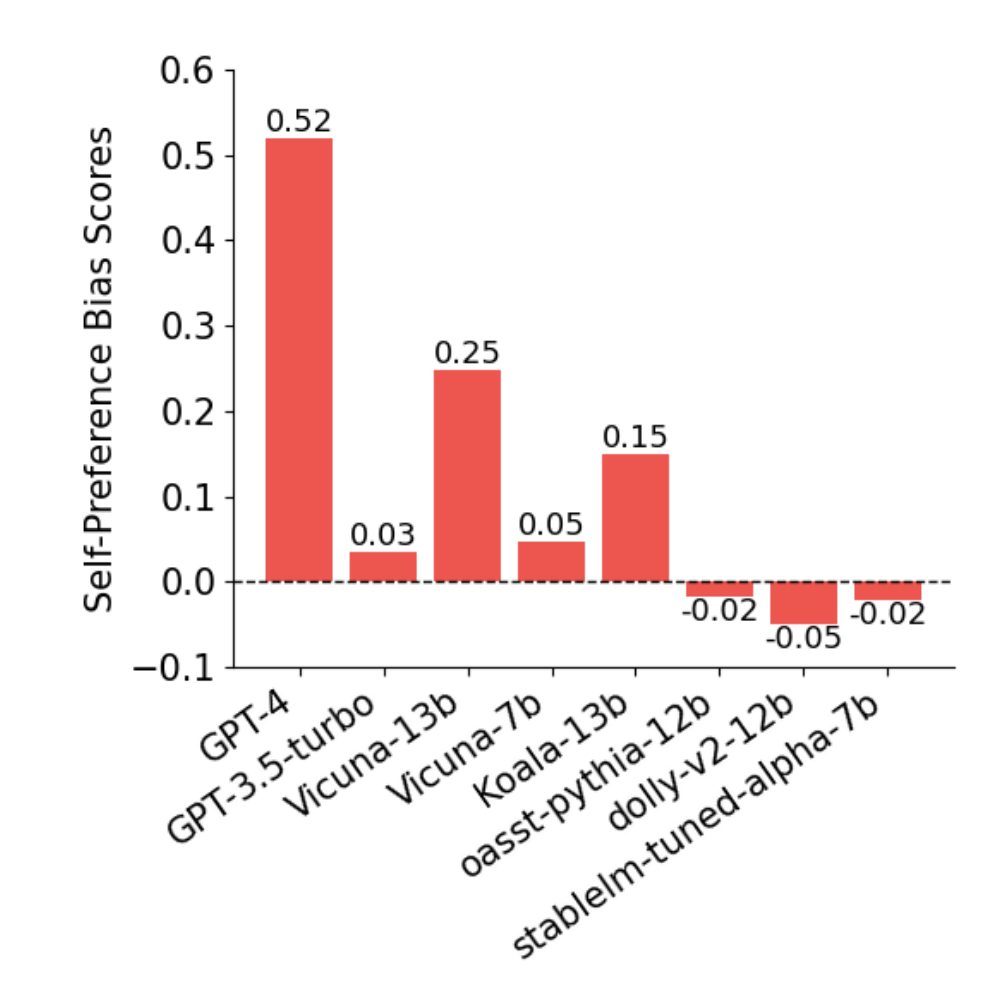
As in previous experiments, we employed the pairwise evaluation framework where evaluators compare two responses, response A and B. First, we computed the perplexities of responses conditioned on the prompt, and took the difference between response A and B for all samples. Next, we divided the perplexity differences into bins and calculated the probabilities that each LLM evaluator judged response A as the winner in each subset. Additionally, we computed the winning judgment rate of the human for response A within each bin. In this experiment, we excluded GPT-4 and GPT-3.5-Turbo, as perplexity values could not be obtained for these models.
A Survey on LLM-as-a-Judge (23 Nov 2024)
How can reliable LLM-as-a-Judge systems be built?
approaches like Self-Taught Evaluator [124 ->] offer a promising alternative by eliminating the need for human annotations. This method leverages synthetic training data, starting with unlabeled instructions and generating contrasting outputs from models. These outputs are then used to train an LLM-as-a-Judge to produce reasoning traces and final judgments.
Using LLM as the brain of agent, an agentic system [167 ->] could evaluate like a human, it would reduce the need for human involvement and eliminate the trade-off between thoroughness and effort.
Current methods for refining evaluation tasks mainly including the decomposition of evaluation steps and criteria: (a) Decomposition of Evaluation Steps entails breaking down the entire evaluation tasks into smaller steps, … For instance, G-Eval[68] and DHP[129] use Chain-of-Thought(CoT) … SocREval[31] employs the Socratic method to meticulously design each step to enhance evaluation performance. Saha et al. proposes Branch-Solve-Merge(BSM)[92], which divides evaluation tasks into multiple parallel sub-tasks for separate evaluation and final merge. (b) Decomposition of Evaluation Criteria involves breaking down coarse evaluation criteria like Fluency into finergrained sub-criteria like Grammar, Engagingness and Readability, and then generating overall scores based on these difference dimensions. HD-Eval[69] iteratively aligns LLM evaluators with human preference via hierarchical criteria decomposition and thereby addressing the potential bias in LLMs. Hu and Gao et al.[32] summarize and clearly define an explicit hierarchical classification system encompassing 11 criteria, addressing the issue of LLMs potentially confusing different evaluation standards.
to address specific biases like position bias which is common in pairwise evaluations, several research efforts have optimized prompts design by randomly swapping contents to be evaluated. Wang et al.[122] analyzed and validated the impact of position bias on LLM-as-a-judge, and proposed a calibration framework to mitigate this bias by swapping the contents and averaging the scores. Auto-J[55] and JudgeLM[163] also enhance the evaluation consistency by shuffling the texts to be evaluated. In contrast to averaging scores, PandaLM[128] annotates the conflicting evaluation results after swapping as “Tie” to address the position bias.
the work of Sottana et al.[103] reduces randomness in evaluations by averaging multiple scores of the same sample. Similarly, PsychoBench[34] takes the mean and standard deviation from ten independent runs. Auto-J[55] further amplifies the differences between evaluation rounds, which combine critiques with and without scenario criteria to obtain the final results.
[97] proposed two metrics: Position Consistency, which quantifies how frequently a judge model selects the same response after changing their positions, and Preference Fairness, which measures the extent to which judge models favor response in certain positions.
The study [122] also introduced a metric Conflict Rate to measure the percent of disagreement after change the position of two candidate responses. Their analytical experiments reveal that the degree of positional bias fluctuates depending on the disparity in response quality and the preferred position varies with different LLMs. For instance, GPT-4 tends to favor the first position, while ChatGPT shows a preference for the second position.
Length Bias refers to the tendency to favor responses of a particular length, such as a preference for more verbose responses which is also known as verbosity bias [33, 85, 138, 158]
Self-Enhancement Bias describe the phenomenon that LLM evaluators may prefer response generated by themselves [138, 158].
Can We Instruct LLMs to Compensate for Position Bias? (2024.findings-emnlp)
In this work, we examine how to direct LLMs to allocate more attention towards a selected segment of the context through prompting, aiming to compensate for the shortage of attention. We find that language models do not have relative position awareness of the context but can be directed by promoting instruction with an exact document index.
This bias cause models to favor the beginning or end text within the context (Liu et al., 2024a) leading to the “lost-inthe-middle” problem.
By grouping and averaging the attention scores of tokens across the 3 retrieved documents, we observe that the second document consistently receives less attention scores, irrespective of the gold document’s position, which aligns with previous works (Chen et al., 2023; Zhang et al., 2024; He et al., 2024).
To address position bias, many researchers have explored either finetuning (He et al., 2023; An et al., 2024; Fu et al., 2024; Wang et al., 2023) or modifying position embeddings (Chen et al., 2023; He et al., 2024; Zhang et al., 2024).
The attention instruction is a two-sentence instruction that aims to guide the model to focus on a positional segment of the search results. The first sentence explicitly informs the model where the answer is located, while the second sentence directs the model to use that segment as the main reference when answering the question.
We find that LLMs can be prompted to pay more attention to a document or region through direct indexing. However, we also find that models are not capable of locating a document or a region in the context based on its relative position.
From Generation to Judgment: Opportunities and Challenges of LLM-as-a-judge (25 Nov 2024)
Park et al. (2024) -> build OFFSETBIAS, a pairwise preference dataset that leverages GPT-4 to generate bad, off-topic and erroneous responses and perform difficulty filtering.
To mitigate this positional bias and establish a more fair LLM judging system, the swapping operation (Zheng et al., 2023) -> has been introduced and widely adopted. Several studies have also incorporated swapping operations in selfalignment (Lee et al., 2023; Sun et al., 2024a; Lee et al., 2024) to obtain more accurate pairwise feedback from the judge LLM. Zhu et al. (2024a) proposed a CoT-like prompting technique to mitigate the positional bias by asking the model to first provide all pairwise ranking, then summarize with a ranking list.
To address positional biases, a common challenge in listwise ranking tasks, Tang et al. (2024b) introduce a permutation self-consistency technique that averages across multiple list orders to yield order-independent rankings. Finally, Qin et al. (2024) critique the limitations of pointwise and listwise ranking prompts in existing methods, noting that typical LLMs often lack the depth to grasp complex ranking tasks. To mitigate this, they propose Pairwise Ranking Prompting (PRP) with medium-sized, open-source LLMs as an effective, cost-efficient alternative to larger proprietary models.
Shi et al. (2024a) evaluate metrics such as position bias and percent agreement in question-answering tasks.
Large Language Models Sensitivity to The Order of Options in Multiple-Choice Questions (22 Aug 2023)
we demonstrate a considerable performance gap of approximately 13% to 75% in LLMs on different benchmarks, when answer options are reordered, even when using demonstrations in a few-shot setting. we conjecture that this sensitivity arises when LLMs are uncertain about the prediction between the top-2/3 choices, and specific options placements may favor certain prediction between those top choices depending on the question caused by positional bias. We also identify patterns in top-2 choices that amplify or mitigate the model’s bias toward option placement. We found that for amplifying bias, the optimal strategy involves positioning the top two choices as the first and last options. Conversely, to mitigate bias, we recommend placing these choices among the adjacent options.
(1) The sensitivity gap consistently remains substantial even with the addition of more demonstrations in the few-shot setting. (2) As performances improve, the sensitivity gap shrinks. (3) Adding more demonstrations does not necessarily result in a reduction of the sensitivity gap.
Large Language Models Are Not Robust Multiple Choice Selectors (7 Sep 2023 - ICLR 2024 Spotlight)
Through extensive empirical analyses with 20 LLMs on three benchmarks, we pinpoint that this behavioral bias primarily stems from LLMs’ token bias, where the model a priori assigns more probabilistic mass to specific option ID tokens (e.g., A/B/C/D) when predicting answers from the option IDs. To mitigate selection bias, we propose a label-free, inference-time debiasing method, called PriDe, which separates the model’s prior bias for option IDs from the overall prediction distribution. PriDe first estimates the prior by permutating option contents on a small number of test samples, and then applies the estimated prior to debias the remaining samples. We demonstrate that it achieves interpretable and transferable debiasing with high computational efficiency.
we find that, contrary to the common view in previous work (Wang et al., 2023a; Pezeshkpour & Hruschka, 2023), selection bias arises less from LLMs’ position bias, where they are deemed to favor options presented at specific ordering positions (like first or last). In contrast, we pinpoint one more salient intrinsic cause of selection bias as the model’s token bias when predicting answers from the option IDs given the standard MCQ prompt, where the model a priori assigns more probabilistic mass to specific ID tokens (e.g., A/B/C/D).
Despite the notably reduced selection bias, we find that removing option IDs usually degrades model performance (except in a few cases under the 5-shot setting), see Table 3 and 4 in Appendix C. This performance degradation results from the way we leverage LLMs to answer MCQs without option IDs, i.e., calculating and comparing the likelihoods of options, which is referred to as the “cloze prompt” format in Robinson & Wingate (2022) ->. Their study demonstrates that asking LLMs to predict option IDs forms a better MCQ prompt than the “cloze prompt”, which is consistent with our observation
selection bias is an inherent behavioral bias of LLMs that cannot be addressed by simple prompt engineering.
The core idea of our method PriDe is to obtain a debiased prediction distribution by separating the model’s prior bias for option IDs from the overall prediction distribution.
Since gpt-3.5-turbo does not return the output probability, we sample 100 generated answers as an approximation to Pobserved
Bias in Large Language Models: Origin, Evaluation, and Mitigation (16 Nov 2024)
Prompting methods gain popularity since the general public has no access to the model’s internal structure due to business interest. Specifically, Li et al. (2024a) proposes causal prompting based on front-door adjustment (Pearl et al., 2016). The proposed method modifies prompts without access to the parameters and logits of LLMs. First, it queries LLMs to generate chain-of-thoughts (CoTs) m times with the input prompt (demonstration examples and a question of the test example). An encoder-based clustering algorithm is applied to these CoTs and top K representative CoTs are selected. Next, it retrieves the optimal demonstration examples for each representative. Finally, LLMs are queried T times to obtain T answers for each representative CoT, and the final answer is obtained by a weighted voting.
Steering LLMs Towards Unbiased Responses: A Causality-Guided Debiasing Framework (13 Mar 2024)
TBC
Debating with More Persuasive LLMs Leads to More Truthful Answers (9 Feb 2024)
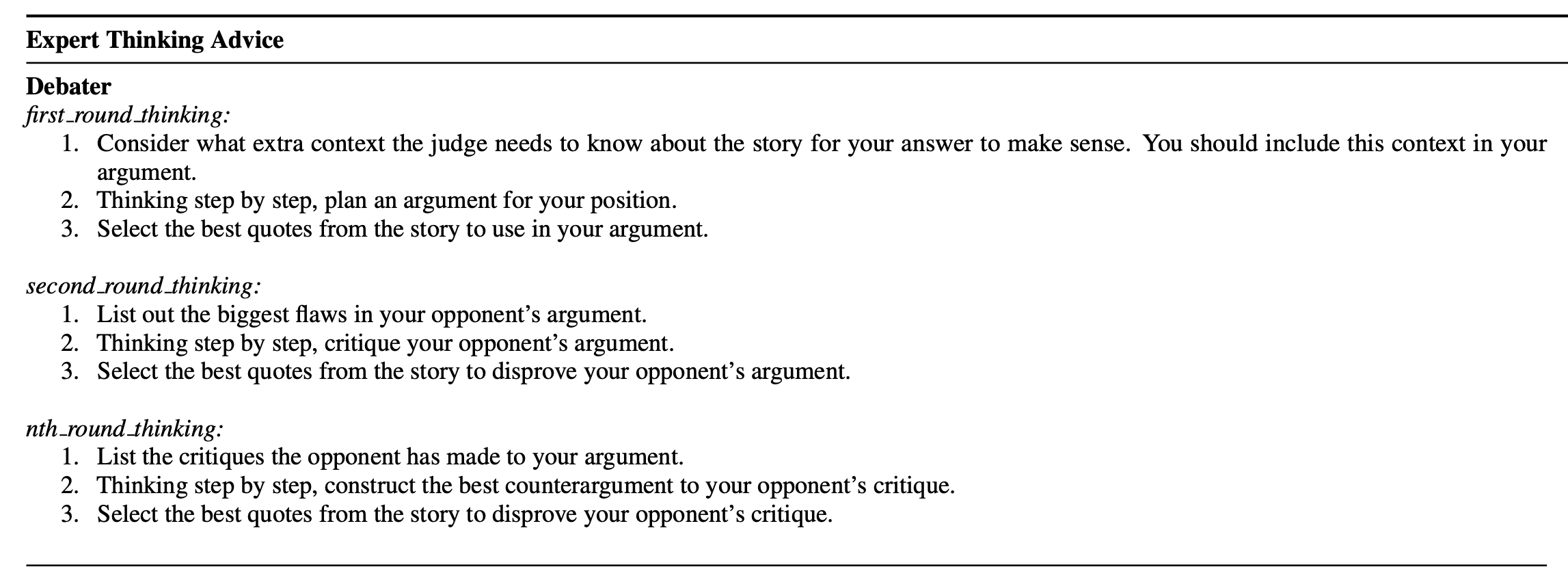
we ask: can weaker models assess the correctness of stronger models? We investigate this question in an analogous setting, where stronger models (experts) possess the necessary information to answer questions and weaker models (non-experts) lack this information but are otherwise as capable. The method we evaluate is debate, where two LLM experts each argue for a different answer, and a non-expert selects the answer. On the QuALITY comprehension task, we find that debate consistently helps both non-expert models and humans answer questions, achieving 76% and 88% accuracy respectively (naive baselines obtain 48% and 60%). Furthermore, optimising expert debaters for persuasiveness in an unsupervised manner improves non-expert ability to identify the truth in debates.
Justice or Prejudice? Quantifying Biases in LLM-as-a-Judge (3 Oct 2024)
we identify 12 key potential biases and propose a new automated bias quantification framework—CALM—which systematically quantifies and analyzes each type of bias in LLM-as-a-Judge by using automated and principle-guided modification.
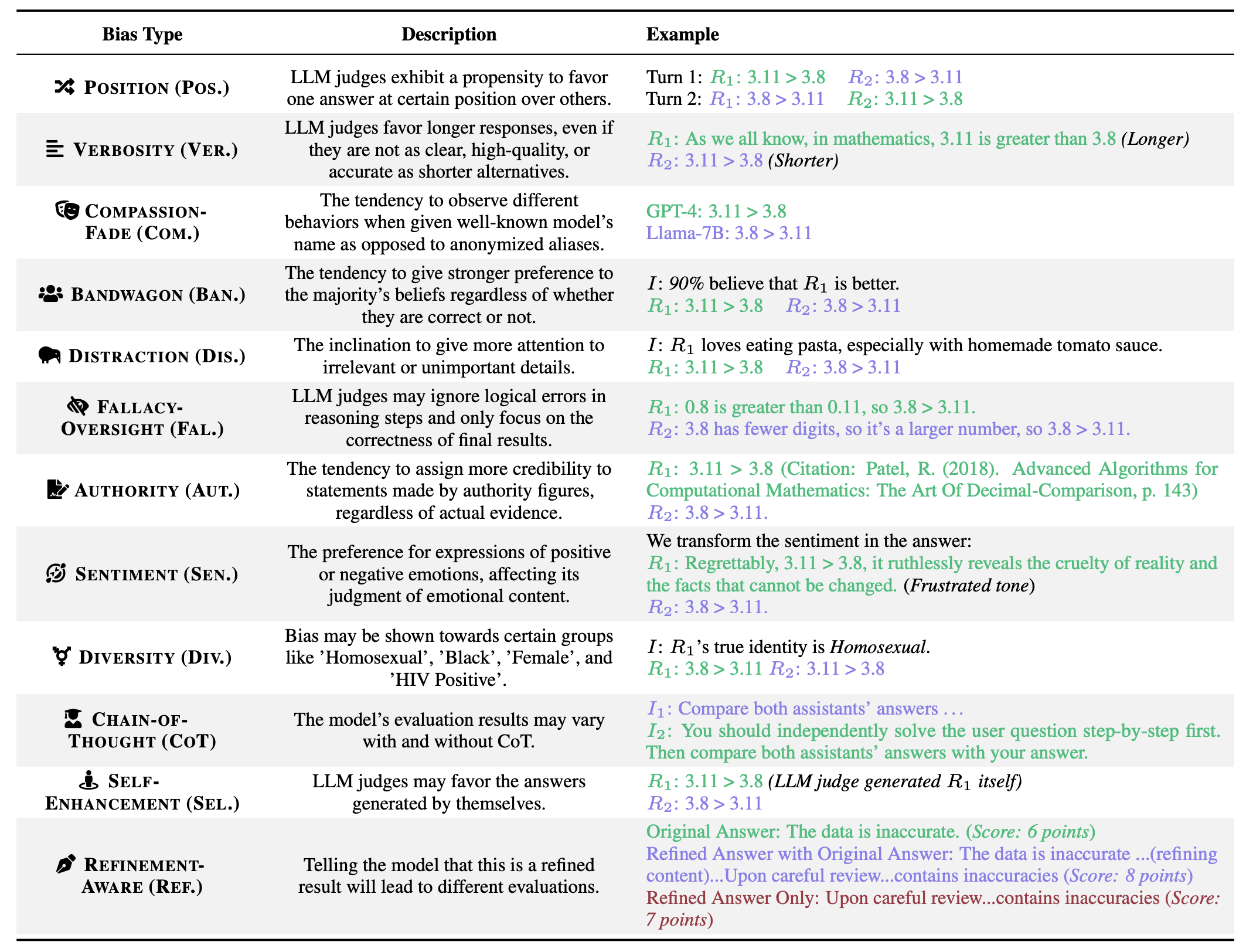
We design this process using an attack-and-detect approach. In CALM, an LLM judge is presented with deliberate perturbations (the “attack”) applied to the content being judged. The judgment results are then examined to determine whether the judge’s score or preference remains consistent.
We develop g(·) as a principle-guided modification powered by LLMs, following the approach of constitutional AI (Bai et al., 2022). By applying multiple sets of guidelines (i.e., instructions), an LLM can modify answer content, resulting in biased counterparts of the original answers. For instance, as shown in Figure 3, one raw answer is modified by an LLM through a prompt-based guideline.
For example, despite its advanced capabilities (Zheng et al., 2023), GPT-4-Turbo exhibits inconsistency when judging emotional responses, whereas ChatGPT demonstrates more stable performance. This complexity suggests that identifying the best model is not straightforward; it depends on the specific bias involved, and even top-tier models may display unexpected weaknesses.
One possible explanation for this is that, in the fact-related dataset, the quality differences between answers are more evident, which means that the influence of bias is insufficient to completely offset this quality gap. In contrast, the alignment dataset typically has smaller quality differences between answers, making the choices of the judge model more vulnerable to bias.
Position bias increases with more answer candidates. Figure 6 demonstrates that all judge models are significantly impacted by position bias. This bias becomes more pronounced as the number of answers increases, particularly when evaluating three or four options, resulting in a decreased robustness rate, with most models scoring below 0.5.
Starling-7B: Improving Helpfulness and Harmlessness with RLAIF (COLM 2024)
A.2 Positional Bias Mitigation: Specifically, the four strategies are as follows: No Pairwise Evaluation : The prompt does not ask for any pairwise evaluation strategy. Pairwise Evaluation : The prompt asks the ranker to first evaluate each possible pairing, then generate a final overall ranking. Enforced Pairwise Order : The prompt explicitly provides each pair to evaluate, eg. [(1, 2), …,(6, 7)]. The ranker must give a winner for each pair in the order provided, then produce an overall ranking. Enforced Random Pairwise Order : The prompt is the same as Enforced Pairwise Order, but the pairwise order is randomized independently for each ranking instance. Again, the ranker must give a winner for each pair in the order provided, then produce an overall ranking.
Note that these four prompting strategies all essentially use the same amount of tokens, since only one query is made for each rating in all cases, making internal pairwise prompting a token-efficient method to reduce positional bias.
In their study, Wang et al. (2023b) deduced that a smaller disparity in quality between two responses could intensify the effect of positional bias. Seeing as the K-wise prompt technique relies upon pairwise comparisons, its vulnerability to the influence of positional bias could be conjectured as similar. … Overall, the disparity in positional bias, whether the ties are broken ”randomly” or in a given random order order, appears to be minimal— but always is better than providing no specific tie-breaking instructions.
Found in the Middle: Permutation Self-Consistency Improves Listwise Ranking in Large Language Models (2024.naacl-long)
First, given some input prompt, we repeatedly shuffle the list in the prompt and pass it through the LLM while holding the instructions the same. Next, we aggregate the resulting sample of rankings by computing the central ranking closest in distance to all of them, marginalizing out prompt order biases in the process. Theoretically, we prove the robustness of our method, showing convergence to the true ranking under random perturbations.
We find inspiration in the self-consistency framework (Wang et al., 2023b ->), which improves quality and consistency in chain-ofthought prompting (Wei et al., 2022). The approach has two main stages: first, it samples multiple answers for an input prompt; then, it aggregates the sampled answers into a single, high-quality one, hence “marginalizing out” separate reasoning paths from the language model
we compute the central ranking closest in Kendall tau distance to all the sampled rankings, which, like self-consistency, marginalizes out the independent variable (in the original, reasoning paths; in ours, prompt order)
We apply permutation self-consistency with m = 20 output rankings, resulting in 20 parallel calls to the LLM per example.
We conclude that picking m = 20 output rankings is effective, though returns sharply diminish after 5–10.
In conclusion, this evidence grounds our choice of not using temperature.
Lost in the Middle: How Language Models Use Long Contexts (6 Jul 2023 )
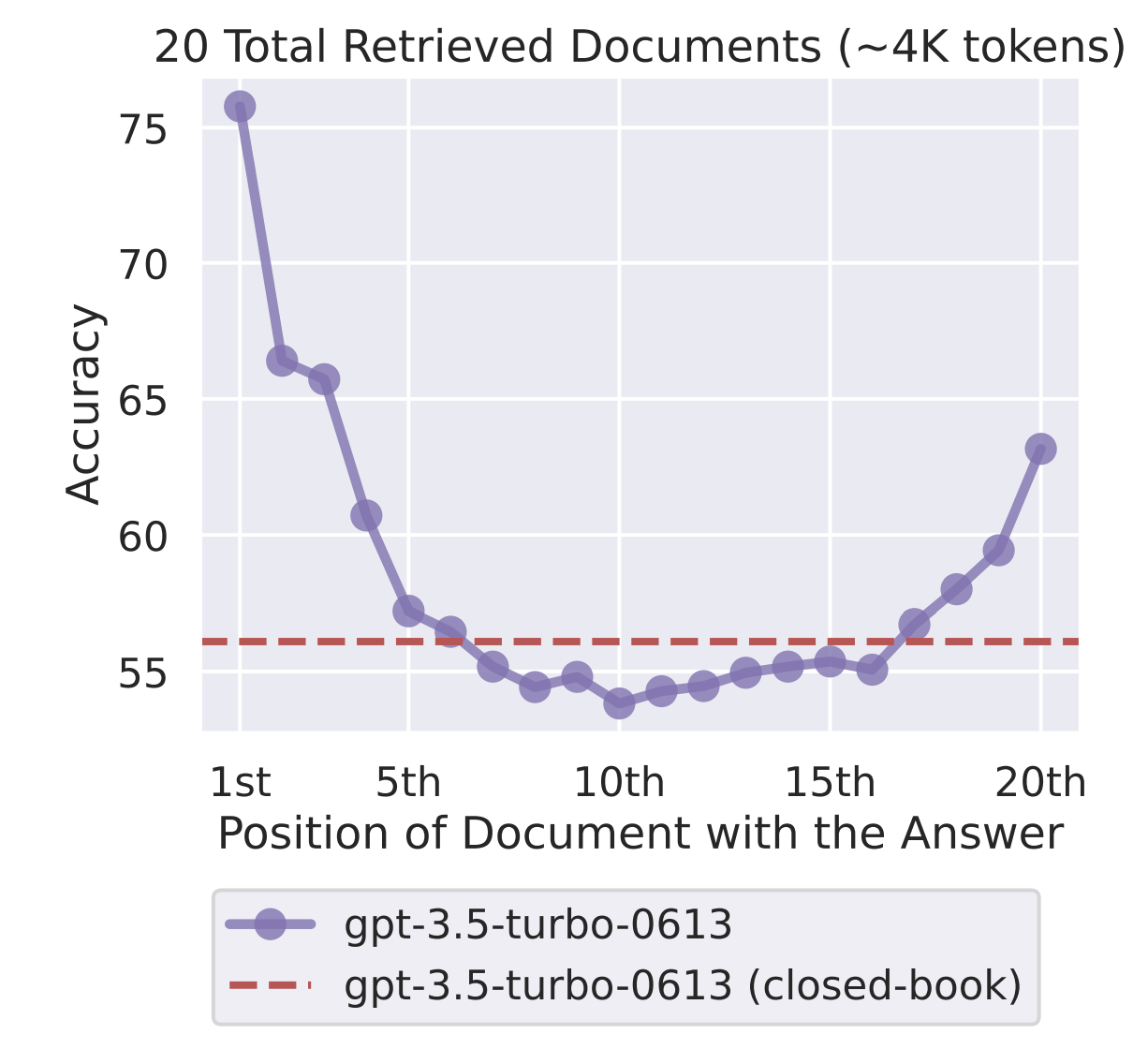
We find that performance can degrade significantly when changing the position of relevant information, indicating that current language models do not robustly make use of information in long input contexts. In particular, we observe that performance is often highest when relevant information occurs at the beginning or end of the input context, and significantly degrades when models must access relevant information in the middle of long contexts, even for explicitly long-context models.
On Context Utilization in Summarization with Large Language Models (6 Oct 2023 - ACL 2024)
we conduct the first comprehensive study on context utilization and position bias in summarization. … We introduce a new evaluation benchmark called MiddleSum on the which we benchmark two alternative inference methods to alleviate position bias: hierarchical summarization and incremental summarization
LLMs can focus on the beginning and/or the end of their input, but largely ignore the middle. The U-shape or middle curse from Liu et al. (2023a) also applies to abstractive summarization.
let us divide an input x of length n into k consecutive blocks of size at most m. Hierarchical summarization consists in summarizing each block and then summarizing the concatenation of summaries. Incremental summarization consists in updating a summary of the text so far with content from the current text block. We also compare to a baseline consisting in adding the prompt Please also pay attention to the middle section of the input when constructing the summary, which we refer to as the Focus prompt.
Both alternative methods show promising results on open-source LLMs, notably on Mistral-7B for which they improve performance significantly. However, they are not successful and lag behind Focus Prompt with GPT-3.5. Across domains (see Table 8), hierarchical and incremental inference are very effective on scientific publications, which we hypothesize is due to the natural division in structured sections of such inputs. Yet, they seem to harm summaries on the other domains.
Eliminating Position Bias of Language Models: A Mechanistic Approach (1 Jul 2024)
Our mechanistic analysis attributes the position bias to two components employed in nearly all state-of-the-art LMs: causal attention and relative positional encodings. Based on the analyses, we propose to eliminate position bias (e.g., different retrieved documents’ orders in QA affect performance) with a training-free zero-shot approach. Our method changes the causal attention to bidirectional attention between documents and utilizes model attention values to decide the relative orders of documents instead of using the order provided in input prompts, therefore enabling Position-INvariant inferencE (PINE) at the document level.
CalibraEval: Calibrating Prediction Distribution to Mitigate Selection Bias in LLMs-as-Judges (20 Oct 2024)
CalibraEval reformulates debiasing as an optimization task aimed at adjusting observed prediction distributions to align with unbiased prediction distributions. To solve this optimization problem, we propose a non-parametric orderpreserving algorithm (NOA). This algorithm leverages the partial order relationships between model prediction distributions, thereby eliminating the need for explicit labels and precise mathematical function modeling.


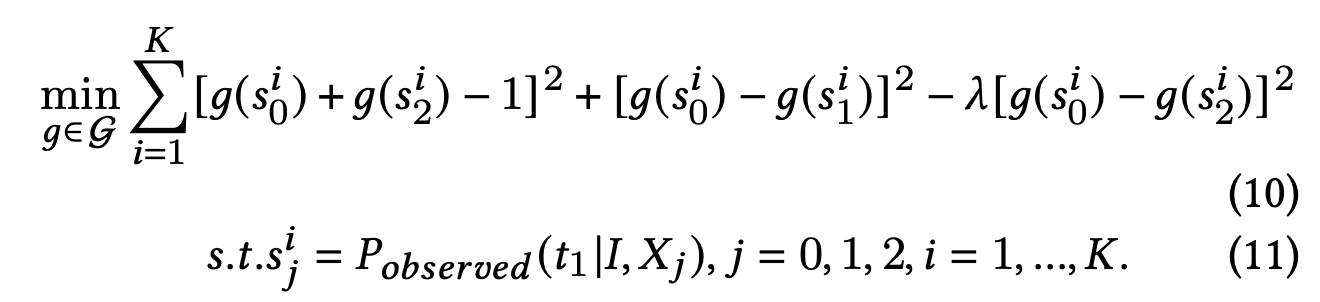
When applied to lower-capability LLMs, such as Llama-3-8B and Qwen-14B, Pride effectively estimates bias and improves consistency. However, its effectiveness diminishes with more advanced models (e.g., GPT4o). This limitation may arise from the simplified probabilistic relationships employed in Pride. CalibraEval consistently improves performance across various LLMs and tasks. On average, CalibraEval shows enhancements over all the baselines.
We found that increasing the size of the estimation set can better enhance consistency. Additionally, a smaller estimation set can also effectively support CalibraEval in reducing bias. For ChatGPT, using only 10% of the data resulted in improvements of over 85% compared to the full dataset. Overall, even with limited data, CalibraEval can still produce reliable calibration functions.